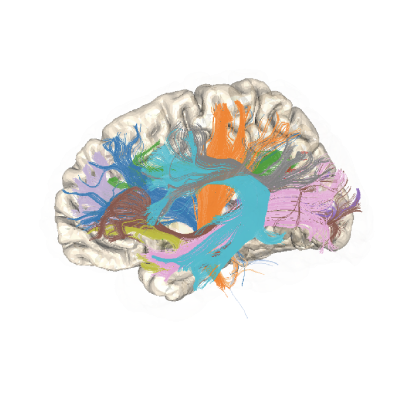
What’s new in PyAFQ 3.0#
Up to now, pyAFQ has focused on the core white matter. This is because the SNR of diffusion MRI is the highest in the core white matter, and tracking is more robust to different methods in the core white matter. Thus, it is easier to find reliable, robust results in the core white matter when using tractometry.
PyAFQ 3.0 shifts the focus to improving AFQ in the superficial white matter. The superificial white matter is the layer of white matter just below the cortex. This is important to relate to functional or structural measures and the gray matter.
A number of changes have been done to support this shift. Principally, pyAFQ now requires a T1-weighted image. This is used to make a brain mask with brainchop. Additionally, it is recommended to provide partial volume estimates (PVEs) from other pipelines such as FSLfast (https://web.mit.edu/fsl_v5.0.10/fsl/doc/wiki/FAST.html) or Freesurfer (https://surfer.nmr.mgh.harvard.edu/). If these are not provided, pyAFQ will generate them using SynthSeg and the T1 [Billot et al., 2023, Billot et al., 2023].
These PVEs are used for tractography, which has been radically changed in pyAFQ 3.0, relative to previous versions: First, we now seed from the white matter gray matter interface to reduce biases in streamline termination points. Second, we propagate using CSD FODs filtered using a unified filtering method to be asymmetric, which is necessary to track in the superificial white matter. Third, we use particle filtering tractography (PFT) [Girard et al., 2014] instead of local tracking, again to better track in the superficial white matter. Fourth, we use anatomically constrained tractography (ACT) [Smith et al., 2012] to ensure streamlines terminate in the gray matter instead of the CSF. Finally, we only consider the middle 60% of identified bundles for cleaning, to allow fanning near the cortex.
There are also a few minor changes, such as the addition of different fitting methods for MSMT [Jeurissen et al., 2014], increased parallelization using Ray and Numba, changes to vertical occipital fasciculus segmentation, and the addition of using IsolationForest to do density-based cleaning for bundles that are not tube-like.
If you would like to replicate the behavior of pyAFQ 2.1, you can do that by referring to the example Running pyAFQ 2.x defaults in pyAFQ 3.x.