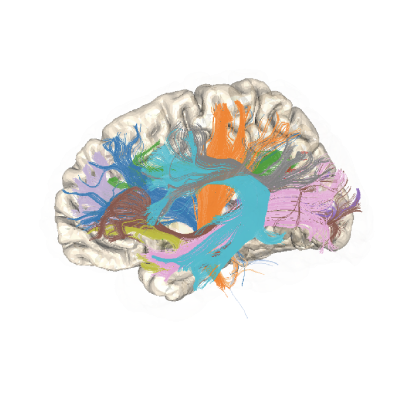
Using RecoBundles for bundle recognition#
For bundle recognition, pyAFQ defaults to use the waypoint ROI approach described in [^Yeatman2012]. However, as an alternative approach, pyAFQ also supports using the RecoBundles algorithm [1], which uses an atlas of bundles in streamlines. This example shows how to use RecoBundles for bundle recognition.
The code closely resembles the code used in the GroupAFQ tutorial.
import os.path as op
import AFQ.data.fetch as afd
from AFQ.api.group import GroupAFQ
import AFQ.api.bundle_dict as abd

afd.organize_stanford_data(clear_previous_afq="track")

tracking_params = dict(n_seeds=25000,
                       random_seeds=True,
                       rng_seed=42)
Defining the segmentation params#
We also refer to bundle recognition as the “segmentation” of the tractogram.
Parameters of this process are set through a dictionary input to the
segmentation_params argument of the GroupAFQ object. In this case, we
use abd.reco_bd(16), which tells pyAFQ to use the RecoBundles
algorithm for bundle recognition. This uses 16 bundles, there is also
an atlas abd.reco_bd(80) which uses 80 bundles.
myafq = GroupAFQ(
    output_dir=op.join(afd.afq_home, 'stanford_hardi', 'derivatives',
                       'recobundles'),
    bids_path=op.join(afd.afq_home, 'stanford_hardi'),
    # Set the algorithm to use RecoBundles for bundle recognition:
    bundle_info=abd.reco_bd(16),
    dwi_preproc_pipeline='vistasoft',
    t1_preproc_pipeline='freesurfer',
    tracking_params=tracking_params,
    viz_backend_spec='plotly_no_mp4')

fig_files = myafq.export_all()